
Finding startups is not the hard part. Deciding which one fits, and proving whether it should scale, is.
Venture Clienting. Source solutions, govern PoCs and decide what scales.
Seven stages from challenge brief to scale decision, under one governed process.
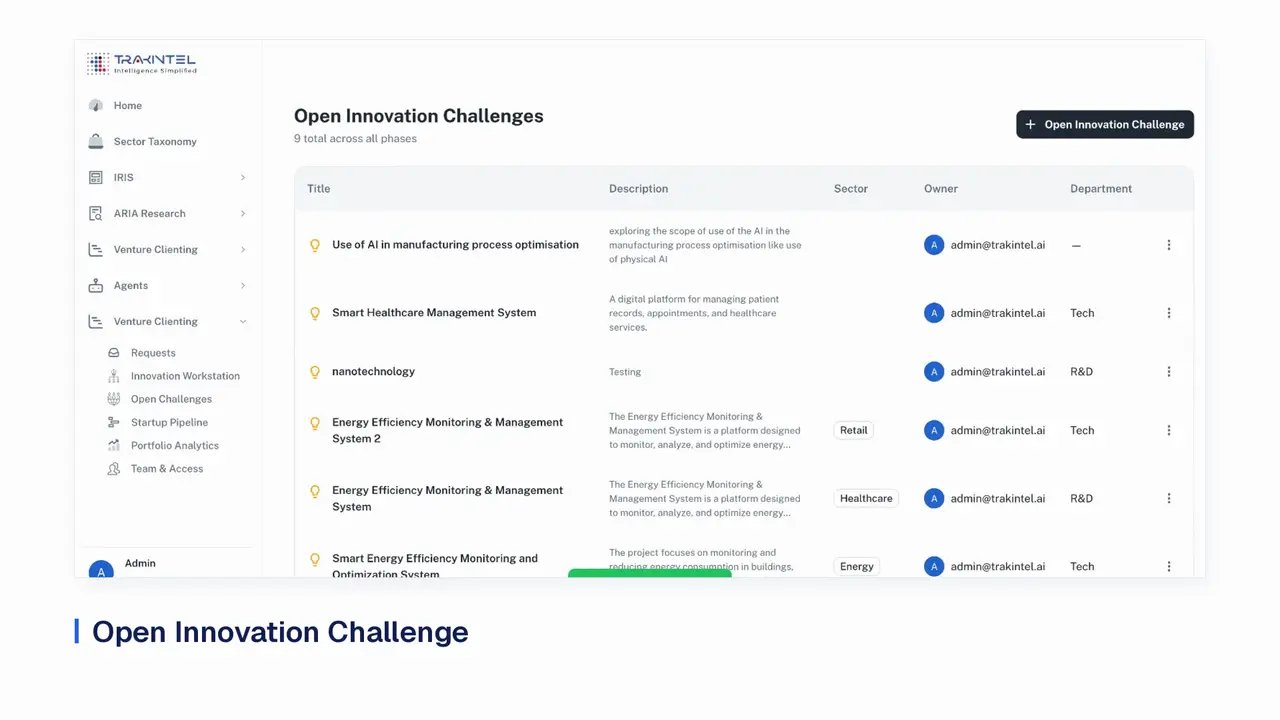

What the walkthrough covers
2 min 18 sec, recorded in the product. Narrated. The list below is what it covers.
Hosted on YouTube. Pressing play loads their player, which sets its own cookies.
- From business challenges to governed pilots, step 1
- Submit, review and route a request, step 2
- Two connected streams: open challenge or internal project, step 3
- The stages a project moves through, step 4
- Defining the problem and the enterprise context, step 5
- The search, and the company data beneath it, step 6
- Stage one: does this startup merit assessment, step 7
- Stage two: how well the solution fits here, step 8
- Stage three: comparing the shortlist, step 9
- The human decision, and the pilot that follows, step 10
- Leadership visibility across the portfolio, step 11
What it does.
What it produces
- Challenge brief
- Curated shortlist
- Evaluation pack
- Governed PoC
- Scale decision
Scouting against a brief
A business unit states the problem in its own terms, and the Scouting Agent searches the graph for providers that fit the requirement rather than the keyword.
Evaluation on shared criteria
Every candidate is assessed on fit, maturity, integration effort, security posture, references and financial standing, so the shortlist can be compared line by line.
PoC governance
The proof of concept runs with an owner, a budget, a timeline and the success measures agreed in the brief. Every change is logged and every approval is recorded.
Scale readiness
FinSight Agent models the unit economics, runs the scenarios and checks readiness for scale, and the decision is recorded with its evidence alongside every other in the portfolio.
Seven stages. Each one leaves something behind.
The hard part is not finding startups. It is deciding which one fits, aligning stakeholders on evidence, running a disciplined pilot and proving the result deserves to scale. Every stage produces a named artifact the next stage starts from.
- 1
Define
Challenge briefA business unit states the problem in its own terms: the process, the constraint, the outcome that would count as success and who has to sign it off.
- 2
Discover
Curated shortlistScouting Agent searches the graph against the brief, not a keyword, and returns a shortlist with the reason each provider made it.
- 3
Evaluate
Evaluation packEach candidate is assessed on the same criteria: fit, maturity, integration effort, security posture, references and financial standing.
- 4
Select
Selection recommendationOne recommendation, with the evidence attached, for the stakeholders who have to agree before money moves.
- 5
Pilot
Governed PoCThe proof of concept runs with an owner, a budget, a timeline and the success measures agreed in the brief. Every change is logged.
- 6
Measure
Outcome reportResults are recorded against the original measures, so the pilot is judged on what it set out to prove rather than on what it happened to show.
- 7
Scale
Scale decisionA decision to scale, stop or extend, recorded with its evidence and visible to leadership alongside every other decision in the portfolio.
What it means for your team.
Pilots start with the signal and the rationale that justified them.
Stakeholders agree on evidence rather than on the loudest sponsor.
Duplicate pilots across business units become visible before they start.
Feeds the decision
Venture clientingA governed proof of concept and a scale decision leadership can see.
The rest of the platform
Bring a real use case.
See how TrakIntel would follow it from the first signal to a governed decision. A domain you monitor, a pilot you are trying to run, or something the board asked.
No confidential or proprietary information is required for the initial walkthrough.