
ARIA turns a technology question into a defensible evidence base.
ARIA. Build technical conviction for internal action.
ARIA turns technical potential into business value, through taxonomy, patents, research, maturity and white space.
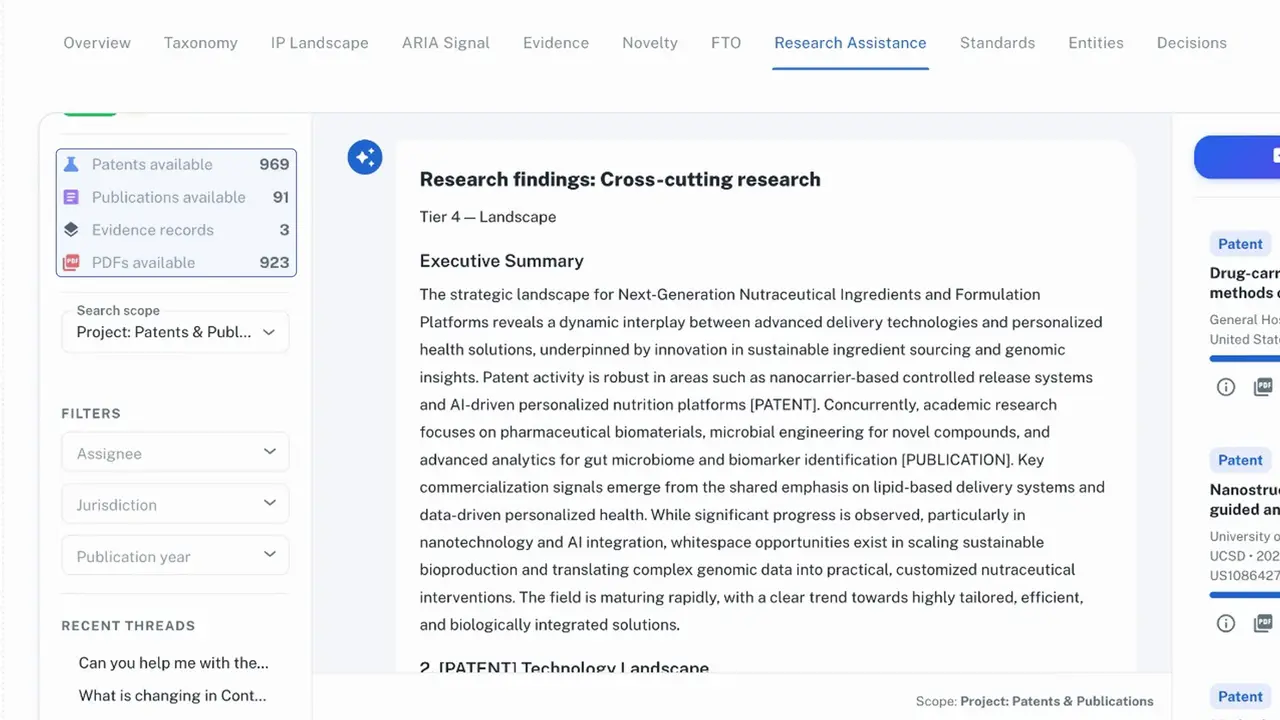

What the walkthrough covers
3 min 8 sec, recorded in the product. Narrated. The list below is what it covers.
Hosted on YouTube. Pressing play loads their player, which sets its own cookies.
- What ARIA is for, step 1
- Starting from a research question, step 2
- Defining the scope of the project, step 3
- The technology taxonomy it builds, step 4
- Patents and publications across that landscape, step 5
- Executive highlights, as structured insight, step 6
- The technology signal matrix: maturity and momentum, step 7
- Evidence packs, including prior art, step 8
- Asking questions across the assembled evidence, step 9
- Freedom-to-operate triage, step 10
What it does.
What it produces
- Technology taxonomy
- Patent and research landscape
- Maturity, hotspots and white space
Technology taxonomy
A domain is broken into the technologies that make it up, so a question about batteries becomes a map of chemistries, manufacturing steps and enabling components rather than one keyword.
Patent and research analysis
Filings and publications are read against the taxonomy: who is active, where activity is accelerating, which institutions and companies keep appearing together.
Maturity and hotspots
Each branch of the taxonomy carries a maturity reading and a hotspot marker, so the team can see what is ready to pilot and what is still a research bet.
White space
The branches where filings are thin and research is rising are named explicitly. That is where an early move is still available.
Conviction is not a feeling. It is a taxonomy, a landscape, a maturity reading and a named white space.
What ARIA reads for a domain
- Patent filings
- Research publications
- Technology taxonomies
- Institutions and assignees
- Filing velocity
- Co-occurrence across the graph
What it means for your team.
Research findings reach the right programme with their evidence intact.
Technical due diligence starts from one assembled evidence base, not five open tools.
The case for a domain is written once and reused by every team that touches it.
Feeds the decision
Research to actionA defensible case that survives the move from research to programme.
The rest of the platform
Bring a real use case.
See how TrakIntel would follow it from the first signal to a governed decision. A domain you monitor, a pilot you are trying to run, or something the board asked.
No confidential or proprietary information is required for the initial walkthrough.