
Six agents. One job each. Your approval on every step.
Agent Studio. Use six focused agents inside governed workflows.
Six agents, one job each, inside workflows you approve. They support the decision. They do not make it.
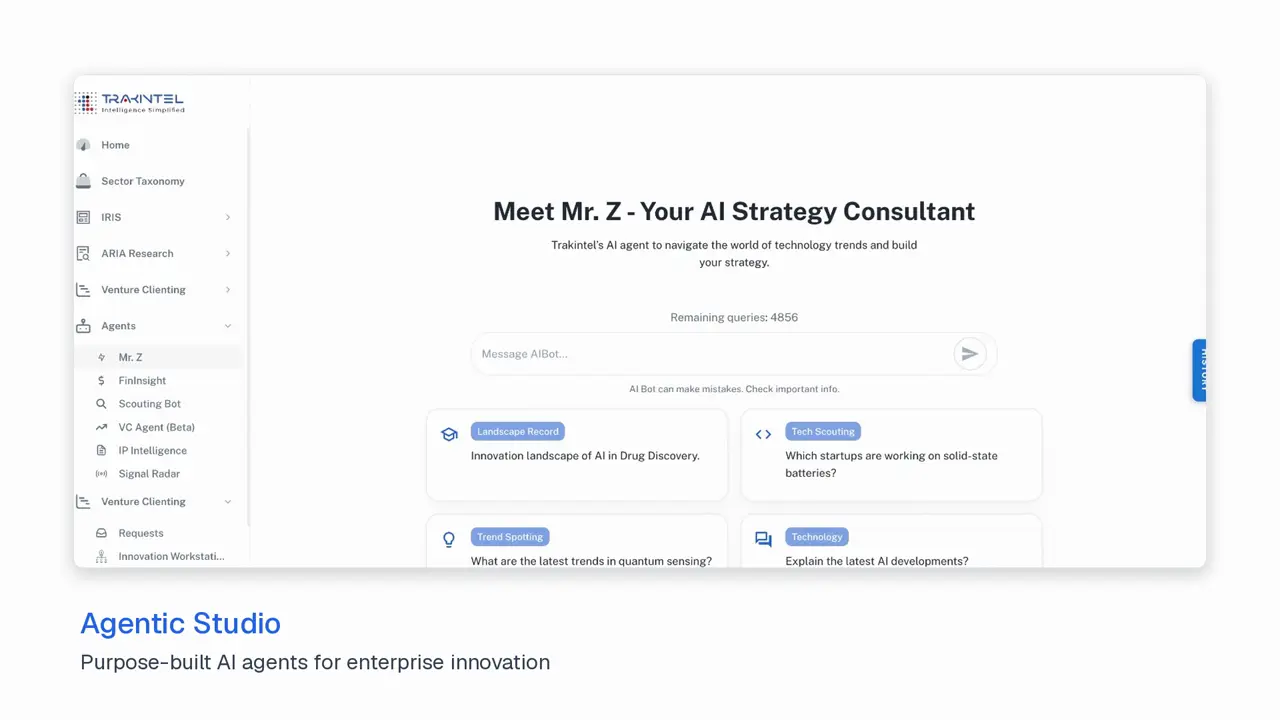

What the walkthrough covers
1 min 54 sec, recorded in the product. Narrated. The list below is what it covers.
Hosted on YouTube. Pressing play loads their player, which sets its own cookies.
- Six specialist agents in one place, step 1
- Choosing the agent that fits the question, step 2
- A strategic question, and how it is framed, step 3
- Reading a structured analysis end to end, step 4
- FinSight Agent: cost, benefit and financial implications, step 5
- Scouting Agent: relevant technologies and providers, step 6
- IP Agent: patents and research, step 7
- Signal Agent: market developments, step 8
- VC Agent: startup and investment analysis, step 9
- Moving between agents as the question evolves, step 10
What it does.
What it produces
- Evidence trail updates
- Drafted shortlists and evaluations
- Recorded approvals
One job per agent
Signal Agent detects. Mr Z positions. IP Agent maps. Scouting Agent finds. FinSight Agent models the numbers. VC Agent writes the case. An agent that does one thing can be checked, and an agent that can be checked can be trusted.
A home system for each
Every agent belongs to IRIS, ARIA or Venture Clienting, reads that system's context and writes back to its evidence trail, so its work is never detached from the workflow.
Governed by the workflow
Agents run inside the stages you define. An agent can draft the shortlist; a person approves it. An agent can build the evaluation; a person selects.
Try it before you buy it
Agent Studio is where a new user meets the platform, and it is on every plan: bring a real question, put it to an agent and read the evidence it brings back. Letting the six agents run inside your workflows unasked is the Enterprise plan's multi-agentic suite, because that needs your approvers and your context set up first.
The six, in detail.
Every agent belongs to one system, reads that system's context and writes back to its evidence trail. An agent that does one thing can be checked, and an agent that can be checked can be trusted.
Signal Agent
Detects change, curates the signals worth reading and tracks momentum as it builds.
- Change detection
- Curated signals
- Momentum tracking
Example question
What changed in solid-state battery manufacturing this month, and is the momentum building or flat?
Mr ZStrategy
Works out the themes, the white space and the adjacency bets, then writes the position brief.
- Themes
- White space
- Adjacency bets
- Position briefs
Example question
Where is the white space next to our automation line, and is an adjacency bet worth a position brief?
IP Agent
Maps the IP landscape, tracks research momentum and reads what each assignee is doing.
- IP landscapes
- Research momentum
- Assignee intelligence
Example question
Map the IP landscape for perovskite tandem cells and show which assignees are accelerating.
Scouting Agent
Discovers startups and partners against a real requirement, and builds the shortlist fast.
- Startup discovery
- Partner discovery
- Shortlists
Example question
Find providers of predictive maintenance for rotating equipment with a European reference customer.
FinSight Agent
Models the unit economics, runs the scenarios, sizes the return and checks readiness.
- Unit economics
- Scenarios
- Return modelling
- Readiness checks
Example question
What would scaling this pilot to four plants cost, and what return does the base case show?
VC Agent
Writes the investment memo and the diligence brief, pulls the comparables and builds the conviction case.
- Investment memos
- Diligence briefs
- Comparables
- Conviction building
Example question
Write the diligence brief on the shortlisted vendor, with comparables and the case for conviction.
Agents support the workflow. They do not replace the decision.
What it means for your team.
Analysts spend their time on judgement, not on collection.
Every agent output arrives with its sources, ready to be checked.
Governance is built into the workflow, not bolted on after.
The rest of the platform
Bring a real use case.
See how TrakIntel would follow it from the first signal to a governed decision. A domain you monitor, a pilot you are trying to run, or something the board asked.
No confidential or proprietary information is required for the initial walkthrough.